From 4-0 Down to 147 Glory: Un-Nooh Produces the Snooker of His Life to Stun O'Sullivan

A Dream Written in Chalk Dust
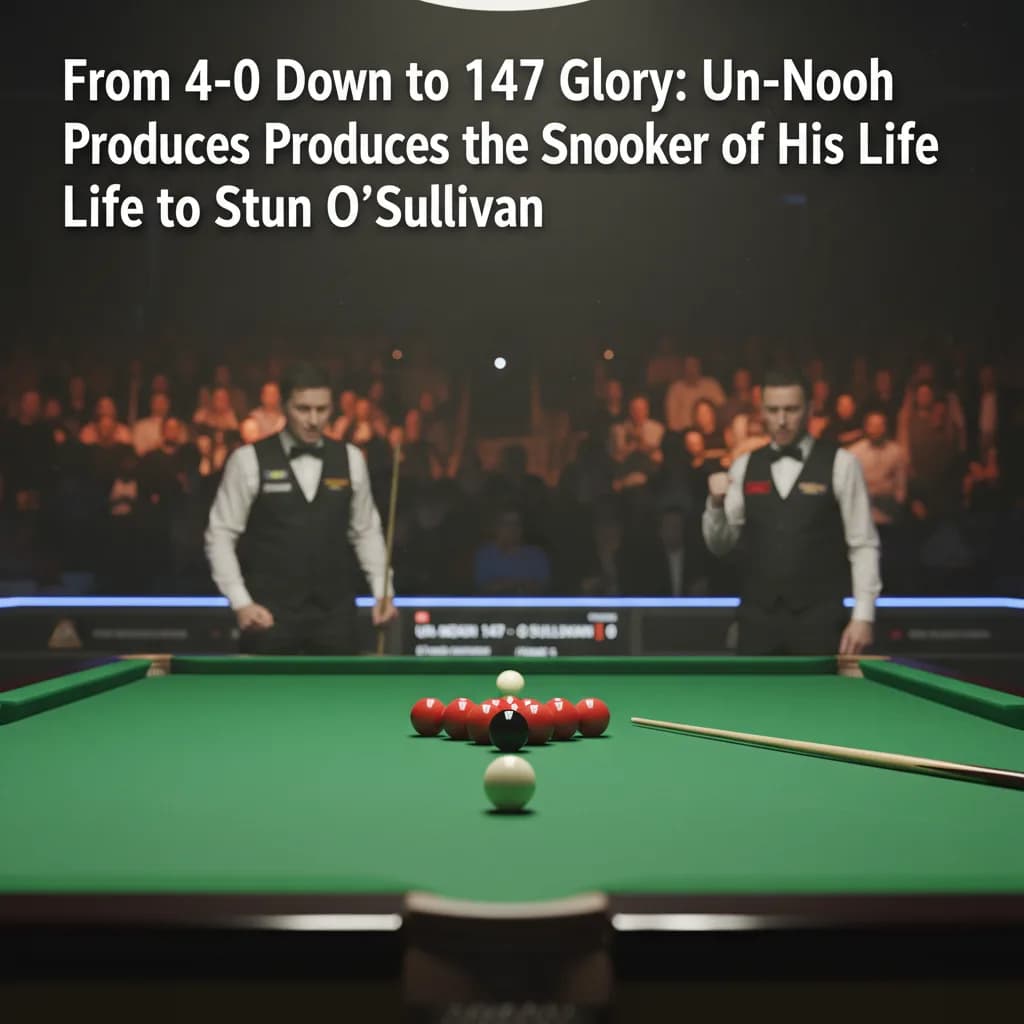
There is a moment in every great sporting upset when the crowd stops breathing. In Yushan's World Open final, that moment came in the penultimate frame — the scores level at 9-7, the tension wound tight enough to snap — when Thepchaiya Un-Nooh stepped to the table, surveyed the reds, and began to do something very few players in the history of the sport have ever done in a ranking final. By the time the final black had dropped, the Thai cueman had completed a perfect 147 maximum break, against Ronnie O'Sullivan, in a world ranking event final. If snooker can produce a more theatrical single moment than that, it is yet to be staged.
Un-Nooh, ranked 39th in the world and seeded 41st for this tournament, finished 10-7 victorious, claiming a £175,000 first prize and only the second ranking title of his career — his first since the novelty sprint of the 2019 Shoot Out. This was something altogether different. This was the biggest occasion of his professional life, and he played like a man utterly unafraid of it.
O'Sullivan's Finest Run Ends Without the Title
To understand just how remarkable Un-Nooh's achievement is, it helps to understand who was standing on the other side of the table. Ronnie O'Sullivan — the Ronnie O'Sullivan — had arrived at this final in the form of a man recapturing something genuinely special. His route to the final had included a break of 153, the highest ever recorded in professional snooker, a number that sits so far beyond the theoretical maximum of 147 that it required a free ball and a flawless execution most players could only dream of. At 50 years old, O'Sullivan was hunting his 42nd ranking title and his first since January 2024, and for long stretches of this final, he looked entirely capable of claiming it.
He opened the match like a thunderstorm. The first four frames went to O'Sullivan in a blur of precise, aggressive snooker — a 124 break among them — and it seemed entirely possible that Un-Nooh, for all his talent, was about to be overwhelmed by the occasion and by his opponent. Instead, what followed was one of the most extraordinary reversals of fortune the sport has seen in recent memory.
The Comeback That Rewrote the Scoreboard
Six consecutive frames. That is what Un-Nooh reeled off from 4-0 down, underpinned by five breaks over 50 and a relentless willingness to attack the table. O'Sullivan, to his enormous credit, refused to buckle quietly. He answered with three consecutive century breaks of his own — 114, 116, and then a crisp 136 — to edge back in front in a contest that had, by this point, transcended any reasonable expectation of quality. Both men were producing snooker that would have looked extraordinary in a practice room, let alone a ranking final under this kind of pressure.
At 9-8 to O'Sullivan, the match remained alive and dangerous. Then Un-Nooh levelled with a break of 77, and something seemed to shift. What followed in the final three frames — breaks of 132, 147, and 131 in succession — was the kind of scoring sequence that commentators reach for statistics to describe, only to find the numbers barely do it justice. Three centuries in a row, the middle one a perfect maximum, to close out a world ranking final. Un-Nooh had already toppled world number one Judd Trump in the semi-finals; now he had beaten arguably the greatest player the sport has ever produced, and he had done it with the sort of snooker that leaves venues silent before they erupt.
"A Double Dream Final"
Afterwards, speaking to the Yushan crowd with the trophy in his arms, Un-Nooh wore the expression of a man still trying to persuade himself it was real. "I just wanted to try my best because I didn't know when I might be in another final again," he said. "It is like a double dream final now. This has always been my dream, to lift the title against Ronnie O'Sullivan in the final. For the rest of my life this is something I'm not going to forget. And to make a 147 in the final against Ronnie O'Sullivan is a great honour."
For a player who had failed to reach the last 16 in any other event this season, it was a result that defies straightforward narrative. Snooker, more than most sports, allows for these explosions of brilliance from players who spend long stretches of a season apparently treading water. Un-Nooh, who had won his two previous meetings with O'Sullivan, clearly harboured no fear of the occasion or the man across the baize.
O'Sullivan, magnanimous in defeat as he so often is when the snooker has genuinely been beyond him, addressed the crowd with characteristic candour. "I watched him play against Judd Trump last night and he made the number one player in the world look second best," he said. "I was hoping he wouldn't play like that today but he did — he gave me a good hiding, really." High praise, delivered with the self-deprecating warmth that has always made O'Sullivan one of the sport's most compelling figures, even in defeat.
Thailand has long produced technically gifted, attacking players capable of lighting up a venue when the mood takes them. On this occasion, Un-Nooh did far more than that. He produced the snooker of his life at precisely the moment it mattered most — and somewhere in the build-up to that penultimate-frame 147, snooker gained another story it will be telling for decades.
