Snooker's 147 Revolution: Why Maximum Breaks Are No Longer the Stuff of Legend

The Numbers Don't Lie — Something Has Shifted
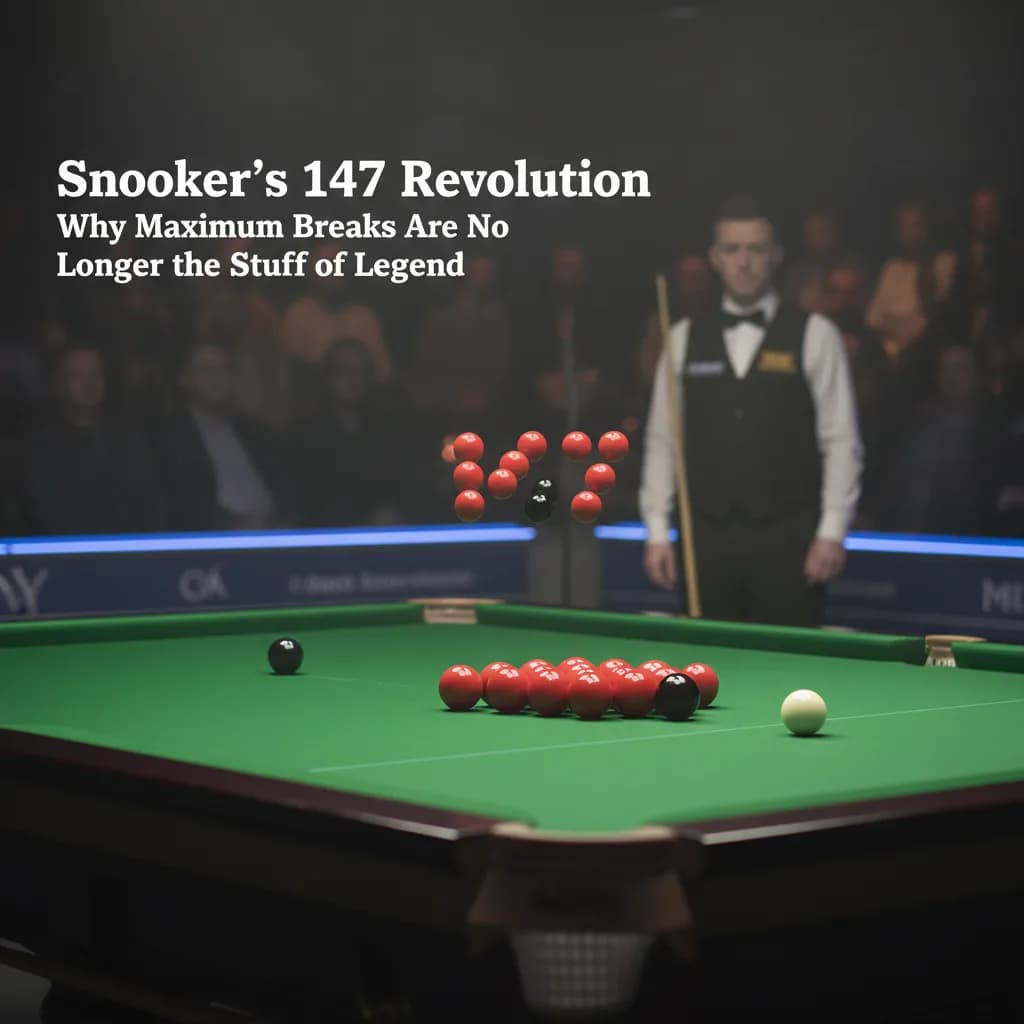
Twenty-five maximum breaks in a single calendar year. Let that sink in. The professional tour has already obliterated its own record in 2025, smashing past 2024's previous best of 14 with such ease it almost feels rude. We are living through a genuine revolution in snooker's standards, and if you're not paying attention, you're missing something remarkable.
At the sharp end of this 147 boom stands, inevitably, Ronnie O'Sullivan. The man turned 50 in December and showed absolutely no interest in going quietly. When he potted his second maximum break at the Saudi Arabia Masters in August — completing the feat within barely two hours of his first — he banked a staggering £180,333 in bonus money in a single session. That is not a misprint. His tally now stands at a record 17 career maximums, a number so far ahead of the field it borders on the absurd. Two 147s in one match. At 50. The audacity is almost offensive.
Murphy and Hill: The New Names Writing History
But here's what makes this story genuinely interesting beyond O'Sullivan's inevitable headline-grabbing: the maximums are spreading. Shaun Murphy, the 2005 world champion and this year's Masters winner, has two 147s to his name in 2025 alone. That puts the Wizard of Wishaw — sorry, the Magician — fourth on the all-time list with 10 career maximums. Murphy himself put it best when reflecting on just how routine the feat has become: he suggested that when Cliff Thorburn made only the second official maximum at the Crucible in 1983, it was a news event on the scale of Steve Cram winning gold in Helsinki. Today, he notes with wry honesty, another 147 barely causes a ripple.
Then there's Aaron Hill. World number 43. Irish. Two maximums in 2025. If the name doesn't immediately ring a bell, it should — he's beaten both Judd Trump and O'Sullivan this season, and he's clearly a player whose ceiling is considerably higher than his current ranking suggests. Chang Bingyu's 147 in November, made during a UK Championship qualifier in Wigan, pushed the 2025-26 season total alone to a record 16 — and the campaign only began in late June, running through to May.
So What's Actually Changed?
The recipe for a 147 remains exactly what it has always been: 15 reds and blacks, then all six colours in sequence. Nothing has been altered. The balls are the same. The pockets are the same. And yet the frequency of maximums has exploded in a way that demands explanation.
The honest answer is that the standard of professional snooker has quietly reached a level that would be unrecognisable to fans from even 30 years ago. Murphy is direct about this: everyone on the tour now could make a 147. That is a staggering statement when you consider that Steve Davis received one of his sponsor's cars as the prize for making the very first official maximum at the Lada Classic in Oldham in 1982. The entire 1980s — a decade we romantically remember as snooker's golden era — produced just eight maximums across all professional competition. One long-time Crucible spectator who also attended World Championship qualifiers in Stockport in the early 1980s put the gulf in standards into sharp perspective, noting that back then you'd be lucky to see a fifty break all day. The glory days mythology, it turns out, has always been somewhat overcooked.
What This Means for the Sport Going Forward
The broader implication here is significant. If Murphy is right — if genuinely every professional on tour is capable of a 147 — then snooker's maximum break has completed a remarkable journey from near-mythical achievement to a marker of consistent excellence rather than once-in-a-generation brilliance. That is not a diminishment of the feat. If anything, it speaks to a sport that has quietly become the most technically demanding it has ever been.
For punters, it also changes the market landscape. The 147 break specials available across major tournaments — offered by the likes of Bet365, William Hill, and Betway — are worth monitoring with fresh eyes given the current frequency. At major televised events with bonus prize pots attached, the incentive to attempt and complete a maximum is higher than ever. With 25 already in the calendar year and the season still running deep into spring, backing at least one maximum at any given ranking event is no longer the long-shot punt it once was.
O'Sullivan may have been knocked out in round one of the UK Championship in York, but his broader legacy on this particular subject is cemented. He didn't just break the record for career maximums — he made two in an afternoon and charged £180,000 for the privilege. At 50. Some things in snooker change. Others, mercifully, do not.
Please gamble responsibly. Visit BeGambleAware.org or call the National Gambling Helpline on 0808 8020 133.
