Thirty Years On: The Night Higgins, O'Sullivan and a Missed Pink Changed Everything

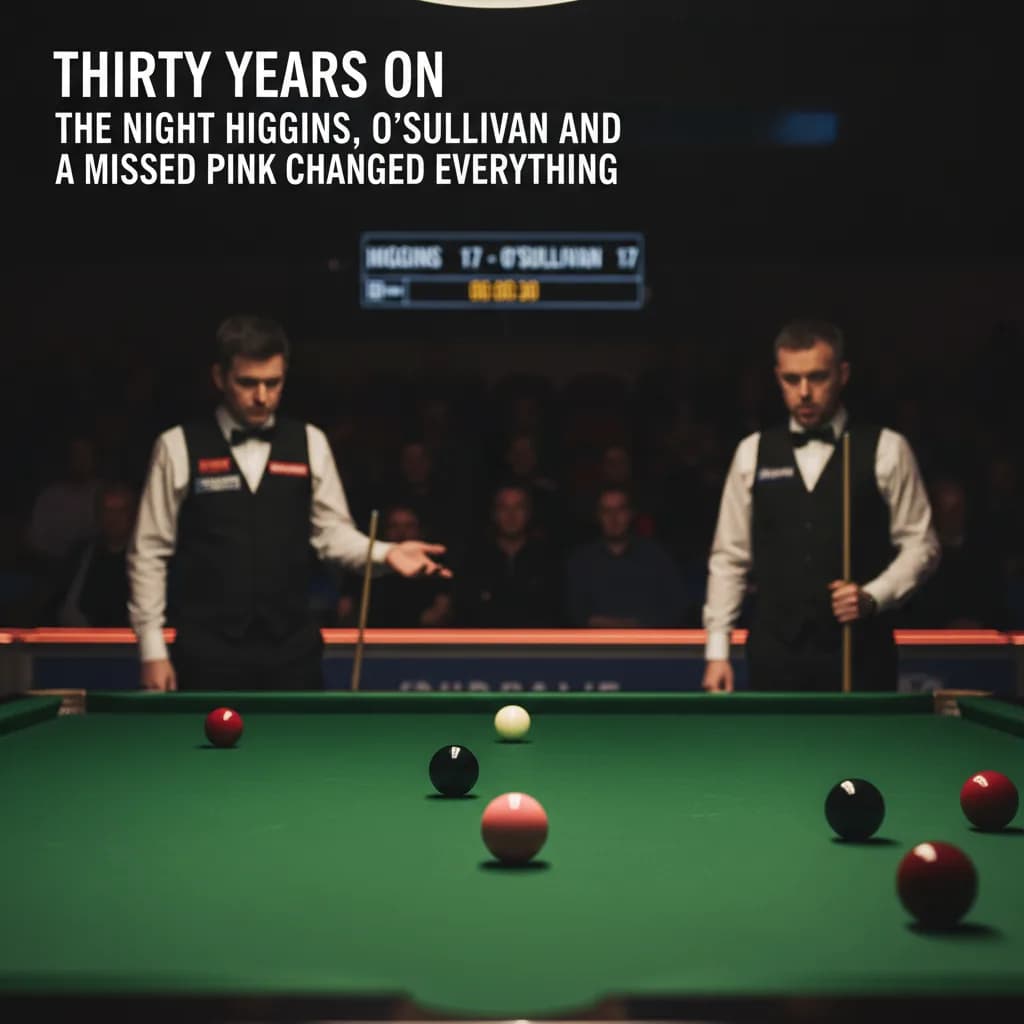
A frame that still haunts Sheffield's most enduring rivalry
Close your eyes and picture the Crucible in 1996. Two twenty-year-olds, barely old enough to order a pint without being questioned, are slugging it out frame for frame in a World Championship quarter-final that nobody in that tight, electric theatre wants to end. John Higgins leads 12-11. The colours are sitting neatly on their spots. The semi-finals are two pots away.
"I've got an easy clearance with the colours," Higgins recalled this week, his memory of that April evening as sharp as a freshly chalked tip. "I normally pot the brown and just play off the side cushion and be above the blue." The shot he chose instead — stunning the blue down the table under the creeping weight of pressure — left him stranded. He went round the cushions, found himself on a brutally awkward rest shot, and then, agonisingly, missed the pink. Ronnie O'Sullivan, waiting like a coiled spring in the other chair, cleared up. The decider was his. Higgins was out.
Even the great Ted Lowe, whose velvet tones had narrated so many Crucible dramas, seemed to sense disaster approaching. "The butterflies must be floating around his tummy," the legendary BBC commentator observed, watching Higgins survey those colours. He was not wrong.
What might have been
"I might have won the World Championship two years earlier than I did," Higgins admitted with the rueful smile of a man who has made peace with something that still quietly stings. He finally lifted the trophy in 1998, the first of his four world titles. Whether a 1996 semi-final appearance would genuinely have accelerated that journey we can never know, but the thought lingers. "It was a brilliant game. We were only 20 and it was a slugfest, shot for shot. They are the ones that give you a bit of steel going forward — the games that make you as a player."
There is something deeply human in what Higgins said next, something that any sportsperson who has ever lain awake replaying a defeat will recognise immediately. "You never think of your good wins. It'd be great if you thought of your good wins, but you always think of the ones that got away." Thirty-four years as a professional, four world titles, and it is still a missed pink in a Sheffield quarter-final that surfaces unbidden.
The remarkable circumstances nobody quite remembers
What lends that 1996 match an almost cinematic quality is the chaos that preceded it. The night before their quarter-final, O'Sullivan faced a disciplinary hearing after assaulting a World Snooker press officer. He could, in theory, have been removed from the tournament entirely. While Higgins sat in his hotel waiting to learn whether he might be handed a walkover, O'Sullivan was being fined £20,000 and handed a suspended two-year ban. He would play on.
"There were conflicting reports that he was going to get thrown out," Higgins recalled of those strange, uncertain hours. To then walk out onto the Crucible stage the following day, with all of that swirling around him, and produce the kind of snooker that pushed one of the sport's most gifted young players to the very limit — it tells you everything about the singular, occasionally maddening force of nature that O'Sullivan has always been.
O'Sullivan's run did not end in triumph that year, for what it is worth. He lost in the semi-finals to Peter Ebdon, who was himself defeated by Stephen Hendry in the final. But the narrative thread that began in that quarter-final — two generational talents, circling each other across decades — has never really stopped unspooling.
A rivalry that refuses to age
Between them, Higgins and O'Sullivan have accumulated fifteen World Championship titles — O'Sullivan's seven to Higgins' four, with the Scot also claiming four UK Championships and three Masters to cement his place among the sport's true immortals. They have shared a Crucible stage more times than most players manage in a career, and yet the appetite for another chapter never seems to diminish.
As they prepare to renew that rivalry once more, Higgins' reflection on 1996 serves as a reminder of why this particular match-up carries a weight that statistics alone cannot capture. It was forged not just in trophy rooms and ranking lists, but in a single, excruciating moment — a rest shot, a missed pink, and the sound of a 20-year-old Scot's semi-final dream dissolving in the Sheffield air. "That is one match that sticks in my mind," he said. Thirty years on, it is easy to understand why.
