Twenty Years On: The Boy From Leeds Who Made Snooker Fall in Love With Itself

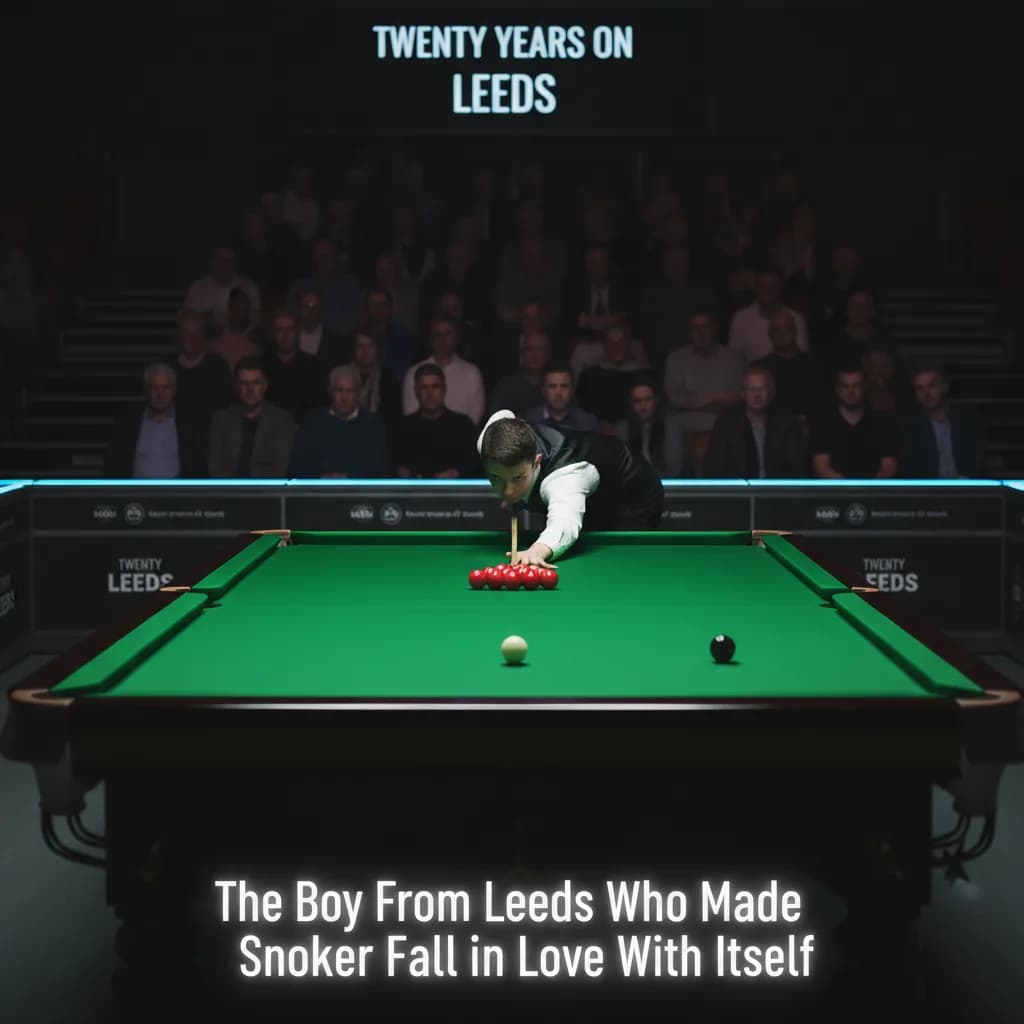
A tiny snooker set on a coffee table. That was all it took.
Paul Hunter was three years old when snooker got its hooks into him — not in a sports hall, not watching the Crucible on television, but in his family's living room in Leeds, potting balls across a miniature table that sat on his parents' furniture. His mum Kristina could never have imagined what that modest Christmas present would set in motion. "We'd never have known in a billion years Paul would become a professional snooker player," she says today, twenty years after losing her son to cancer just days before his 28th birthday. "But he just loved it."
His father Alan remembers a boy who simply could not be pulled away from the game. "He never stopped. He would play every night after school." By the age of eight, Hunter had outgrown the coffee table entirely and was badgering his dad to take him to a local club where full-size tables awaited. Alan relented — and whatever he expected to witness that first evening, it is fair to say the reality exceeded it. The boy who had to stand on a wooden box just to reach the table properly, who relied on the rest for shots that taller players would handle with ease, was already something special.
Nurtured in the North
The club in Yeadon, a quiet suburb a few miles north of Leeds city centre, no longer exists. But for those who were there, it remains the place where a legend was quietly assembled. It was there that Hunter came under the influence of Joe Johnson — the 1986 World Champion from nearby Bradford — who helped shape the young prodigy's game. Later, Hunter would sharpen his skills further at the Guiseley Conservative Club, where local snooker followers like David Lamb and Michael Spence watched on with growing amazement.
"He showed what can be achieved if you work hard at it," Lamb reflects, "because snooker is hard work. It takes hours and hours of practice just to get your cueing straight." Spence's first impression of the teenage Hunter was more succinct. "Unbelievable," he says simply. Among Hunter's regular practice partners at Guiseley was a young Welshman who would go on to become a world finalist — Matthew Stevens. The two became close friends, a partnership of talent and temperament that those who witnessed it still speak about with obvious affection.
The Gamble That Paid Off
As Hunter's obsession deepened through his early teens, homework became something of a theoretical concept in the Hunter household. His parents faced a decision that no doubt kept them awake at night: let him continue as he was, or take the leap. They chose the leap. At fourteen, Hunter left school to concentrate on snooker full-time. Alan and Kristina called it a "gamble" — but in truth, given what they had already seen, it may have been the safest bet they ever made.
Within five years, their son had won his first ranking title. The 1998 Welsh Open, claimed while Hunter was still a teenager, announced him to the wider snooker world with unmistakable force. A year later he broke into the world's top 16, earning his place at the Masters for the first time — and it was at Alexandra Palace where his story would reach its most dazzling chapters. Hunter won the Masters in 2001, 2002 and 2004, a feat that placed him in rarefied company. The tournament, contested exclusively by the elite of the game, is considered one of the most demanding titles in snooker precisely because there is nowhere to hide. Hunter did not want to hide. He wanted to perform.
'Paul Was Fun'
Statistics, of course, only carry a story so far. Six major titles in six years is an extraordinary return for any player, let alone one who would not live to see his thirtieth birthday. But those who knew Hunter — and many who simply watched him — speak less about the trophies and more about the feeling he created around the game. There was a looseness to him, a joy, that was rare in a sport not always known for its levity. He played with a smile that seemed genuine rather than performed, and the crowds responded in kind.
Two decades on from his death in October 2006, the tributes that emerge each anniversary carry a warmth that feels undiminished by time. Snooker has produced many great players. It has produced far fewer characters who made the casual viewer lean forward in their seat simply because something alive seemed to be happening on that table. Paul Hunter was one of those rare things: a player who made the sport better just by being in it. The boy from Leeds who stood on a box to reach the cushion grew into a man who made the whole game feel a little taller. Twenty years on, that legacy has not shrunk by a single inch.
