Robertson Calls for World Championship Format Overhaul: 'Best of 25 Is Enough'

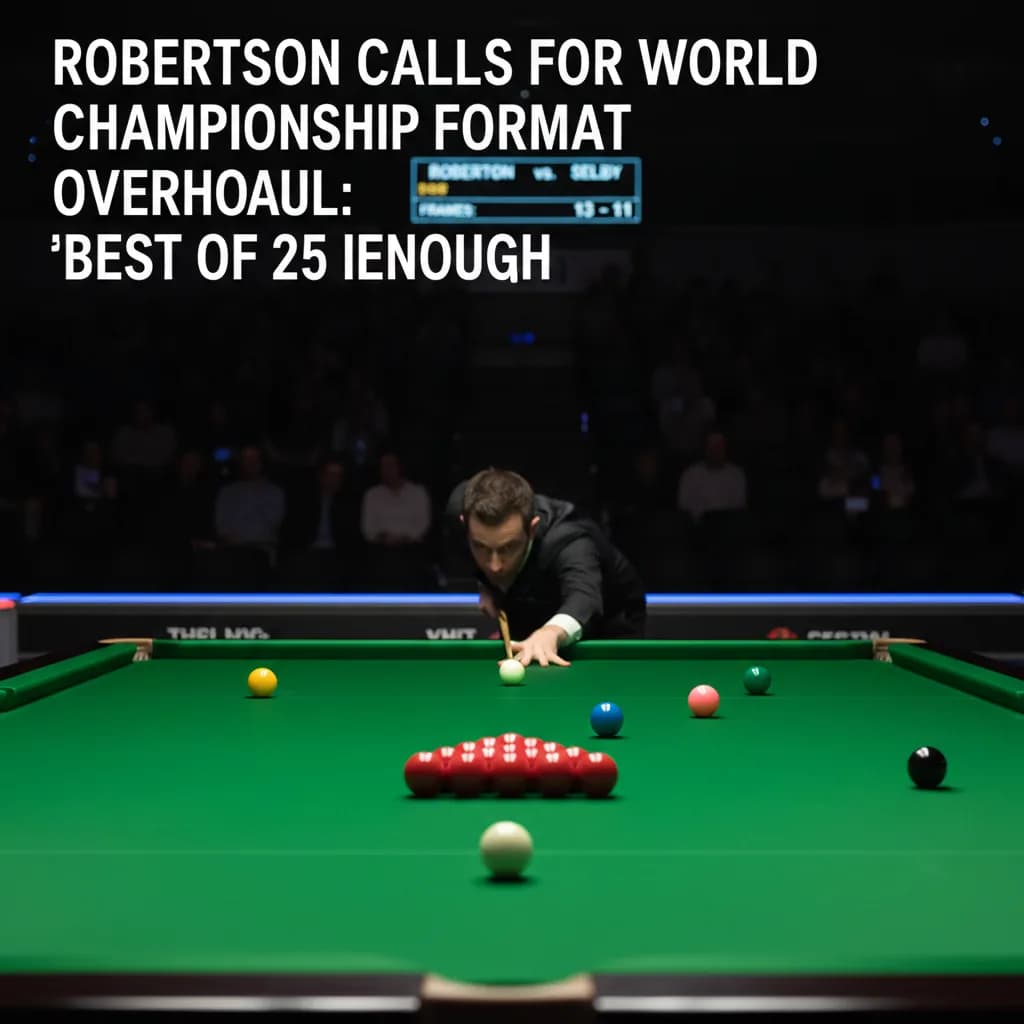
World Number Three Pushes for Shorter Frames Structure at the Crucible
Neil Robertson has added his voice to the ongoing debate surrounding the World Snooker Championship's format, arguing that the tournament's traditional match lengths are no longer suited to the modern game. Speaking to Midnite ahead of his first-round appearance at the Crucible, the 2010 world champion and current world number three outlined a specific restructuring proposal that would standardise frame counts from the second round onwards.
"I mean, the best out of 35 is a very long match," Robertson said. "In today's day and age, I think a best out of 25 is enough. First to 13 – I think it's a great match. It's over three sessions." The Australian, who turns 45 this year, went further in detailing his preferred structure: "Me personally, I would probably change it to once you get to the second round, then it's just best out of 25 for the whole way through."
How the Current Format Compares
Under the existing structure, the World Championship operates on a progressive frame count that has remained largely unchanged for decades. Round one is contested over the best of 19, before the competition steps up to best-of-25 encounters for both the second round and the quarter-finals. The semi-finals are played over the best of 33, while the final retains the sport's most iconic format — best of 35 frames across four sessions. Robertson's proposal would effectively eliminate that escalation from the second round onwards, capping every match from that stage at 25 frames (first to 13).
What makes the semi-final format a particularly reasonable target for reform is the scheduling it produces. The penultimate round at the Crucible regularly generates some of the longest individual days in professional snooker, frequently outlasting even the final itself in terms of session time. The transition from the concluding day of the quarter-finals — widely regarded as among the most compelling snooker of the entire tournament — into the slower opening session of the semis has long drawn criticism for draining momentum from the event's climactic stages.
Robertson Also Targets the 'Snooker Chase' Problem
Beyond the macro-level format debate, Robertson also raised a more granular concern: the habit of players extending frames well beyond any realistic point of recovery when chasing snookers. It is a practice that can add considerable dead time to already lengthy sessions, testing the patience of both live audiences and broadcast viewers.
"I think when players need snookers, sometimes we carry on hoping for that one-in-a-hundred chance that we'll get a free ball and the opponent will fail," Robertson said. His proposed solutions were pragmatic: either impose a time limit on how long a player may pursue snookers, or introduce a points threshold beyond which the frame is automatically conceded. "If you need two snookers, then the frame is over," he suggested.
There is a certain irony in Robertson — a player whose tactical nous and willingness to grind out safety exchanges have defined much of his career — advocating for measures that would accelerate the game's pace. His recent seasons have occasionally seen him drawn into protracted tactical battles, sometimes to his own detriment. Nevertheless, his comments reflect a broader sentiment that has gained traction among players, broadcasters, and administrators alike: that the sport must evolve its presentation to compete for modern audiences.
Robertson Advances at the 2026 Crucible
Whatever his reservations about format, Robertson appeared entirely at ease with the current one during his opening match at the 2026 World Championship. The Melbourne-born cueman completed the second-round line-up on Thursday evening, compiling breaks of 100, 81, 80, and 77 in the process as he saw off qualifier Paul Davison to book his place in the last 16. The century was Robertson's 14th at the Crucible in competitive play (per CueTracker), further underlining his enduring quality on snooker's grandest stage — a venue where, ironically, the format he now wants to shorten has historically provided the canvas for some of his finest performances.
Whether the World Snooker Tour's governing body would entertain such sweeping changes to a format steeped in tradition remains to be seen. The Crucible's marathon structure has long been considered integral to its identity, and the final in particular carries enormous symbolic weight as the sport's longest and most demanding test. Robertson's proposal, however, is notable precisely because it comes from a multiple ranking event winner with deep experience of what those long sessions demand — and what they cost.
