The Crucible Curse: Why No First-Time World Champion Has Ever Successfully Defended Their Title

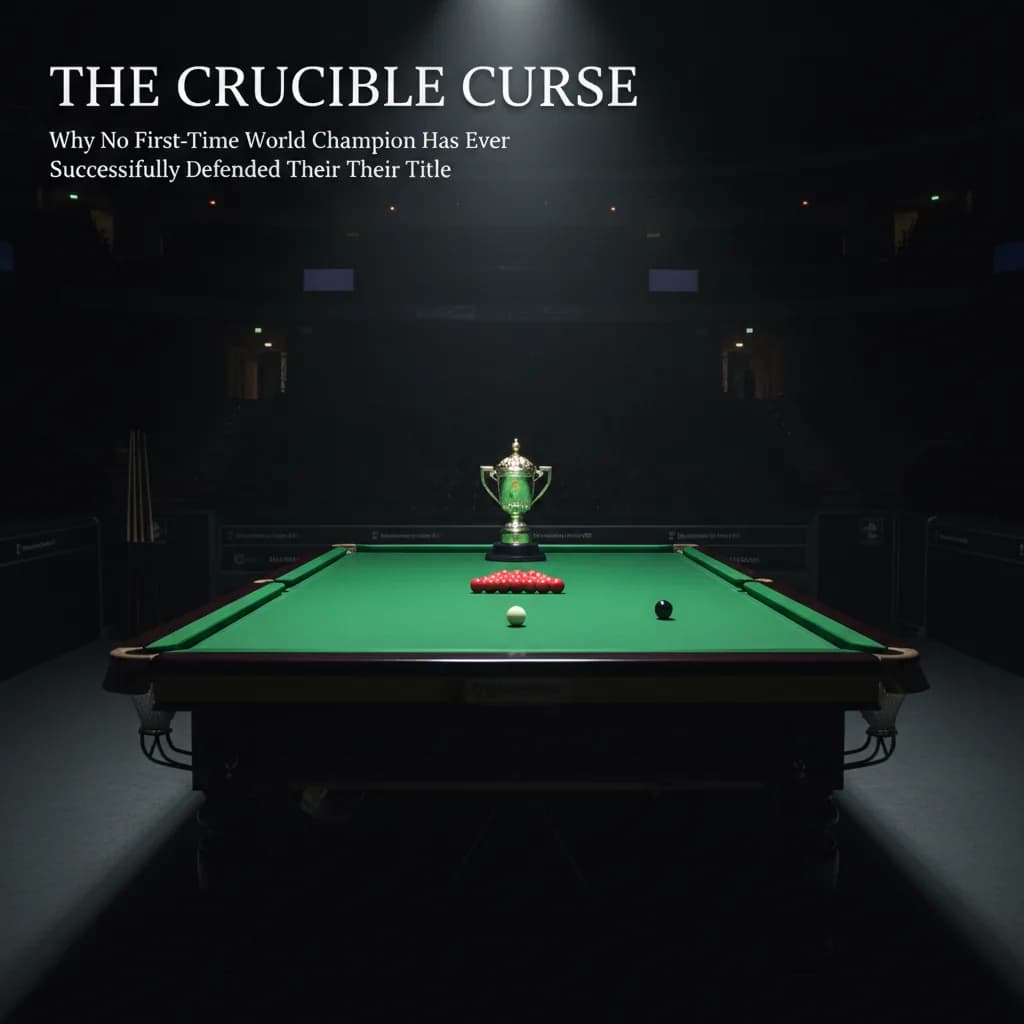
A Trophy That Bites Back
Picture the scene: the winner's podium at the Crucible Theatre, the trophy raised, the Sheffield crowd on their feet. For any snooker player, lifting the World Championship title for the first time is the summit of the sport — a moment years, sometimes decades, in the making. And yet, almost without fail, the players who experience that extraordinary high find themselves tumbling back to earth the following April. Not just beaten, but haunted.
Since the World Snooker Championship made its permanent home at Sheffield's Crucible Theatre in 1977, not a single first-time winner has managed to come back the following year and retain their crown. Twenty champions have tried. Twenty have failed to defend it. The snooker world calls it the Crucible curse — and whether you believe in sporting superstitions or not, the numbers make for uncomfortable reading.
The Record Books Don't Lie
The curse has claimed some of the greatest names the sport has ever produced. Ronnie O'Sullivan — widely regarded as the most naturally gifted player in history — won his first world title in 2001 and returned in 2002 unable to defend it, despite going on to claim the trophy a further six times across the following two decades. Mark Selby, three-time champion and one of the most mentally resilient players of his generation, won his maiden title in 2014 before falling short in 2015. He would eventually win back-to-back titles in 2016 and 2017, but only after that first unsuccessful defence.
Even the great Stephen Hendry — the man who dominated the Crucible through the 1990s with a ruthlessness that left opponents and commentators alike searching for superlatives — could not sidestep the curse after his first triumph. Hendry would go on to win seven world titles between 1990 and 1999, including consecutive victories, but his attempt to defend that initial championship fell flat, just like everyone else's.
The closest anyone has come to breaking the curse were Joe Johnson in 1987 and Ken Doherty in 1998. Both men, having claimed their first world title the previous year, battled all the way back to the Crucible final — only to lose at the final hurdle. For Johnson and Doherty, reaching that final as defending champion was a remarkable achievement in itself. For the curse, it was merely a narrow escape.
Recent Victims — and a New Hope
If anything, the curse has tightened its grip in recent years. Luca Brecel, the flamboyant Belgian who lit up the 2023 tournament with a brand of attacking play that felt almost impossibly audacious, returned to Sheffield in 2024 and was knocked out in the first round by qualifier David Gilbert. The champion's chair, it turns out, offers no protection whatsoever.
Kyren Wilson's fate in 2025 was, if anything, even more brutal. The Kettering cueman had delivered a composed, technically impressive performance to win his maiden title in 2024, and arrived back at the Crucible as champion — only to be sent home in the first round by Lei Peifan, a debutant making his very first appearance at the World Championship. The irony was almost too neat: a man playing his first Crucible match defeating the reigning world champion.
Which brings us to the present. Zhao Xintong's victory in 2025 was genuinely historic — the first Chinese player ever to win the World Championship, a landmark moment for the sport's rapidly expanding global footprint. When Zhao lifted that trophy, he did so in front of a watching audience that stretched far beyond the Crucible's 980 seats, reaching into living rooms across China and sparking celebrations that reflected just how significant snooker's growth in Asia has become. Now, when the 2026 championship arrives, Zhao will carry not just his own ambitions but the weight of 48 years of failed defences.
Why Does the Curse Exist?
Ask players and coaches about the curse and most will bristle slightly at the word — professionals prefer to deal in preparation and percentages, not folklore. And yet there are plausible explanations for why defending a maiden title proves so uniquely difficult. Winning for the first time brings with it a whirlwind of commercial commitments, media appearances and exhibition invitations that can quietly erode the focused routine a player has spent years building. There's also the psychological burden of expectation: arriving at the Crucible as champion rather than challenger changes the dynamic in ways that are hard to quantify but impossible to ignore.
Then there's the simple fact that snooker's depth of talent makes any prolonged dominance extraordinarily difficult. Only Hendry, O'Sullivan and Selby have won the title in back-to-back years since 1977 — and even they couldn't manage it first time around. The Crucible, it seems, has long memories and short patience for those who arrive expecting a coronation.
With the theatre's contract recently extended until 2045, there are at least two more decades of champions ahead — and two more decades of first-time winners stepping back through those famous doors, hoping to be the one who finally silences the curse. Zhao Xintong will be the next to try. The Crucible will be waiting.
